Will, Last
Book / Produced by partner of TOW
One of the most sensitive things we do in life is to write a last will and testament. Doing this confronts us with our own inevitable death—an important and deeply spiritual ministry to ourselves. We are also forced to define who and what is valuable to us and how we wish our possessions to influence people after we die. A will can be a family blessing, a form of gift giving and a means of bringing peace and justice to our families. It can bless charitable organizations and encourage causes we embraced in this life. It can also be a hand extending from the grave to control, manipulate, divide and bring retribution for wounds not healed before we died. So the will reveals not only the state of our financial assets but the state of our souls.
Some people do not bother to make a will, not so much for “spiritual” reasons or even because their assets are comparatively small, but because they do not think it important. They do not survive, of course, to see people fighting over their possessions or the hurts caused because the people assumed to be the proper heirs did not actually receive the promised inheritance. Without a will your family’s assets might be frozen for months; your nearest surviving kin may not have funds to continue normal life; provincial or state laws will determine the distribution of your assets without consideration of your wishes, sometimes ignoring the members of your family who should be the rightful heirs; more of your estate will be spent in administrative costs; and the process may be delayed for months, sometimes for years.
It is not the purpose of this article to advise how a will should be written. Normally this should be done by a lawyer, though simple forms can be obtained in banks, which can be legal, if properly witnessed by two adults who are not beneficiaries, correctly signed and dated. Properly conceived wills name the executor (the person named to administer the will) and the beneficiaries (those who receive specific portions of the estate). They also need to be updated every five years or when there has been a change of residence, marital status or family circumstances. My purpose here is to explore the meaning of writing a will.
Before There Was a Will, There Was a Way
In ancient times the equivalent of the last will was the father’s oral blessing of the family before he died (see Blessing, Family). Isaac’s blessing Esau, his older son, in contradiction to God’s revealed plan of maintaining the family leadership through Jacob (Genesis 25:23) is a classic story of a last will gone awry. In giving his word even in the context of a ruse, Isaac could not recall his promise, though he appointed the one he thought was the right person as leader of the family. God providentially arranged for Jacob to be the bearer of the promise. In Israel such final blessings included a double portion of the estate to the oldest male (Deut. 21:15-17), since this person would be the responsible leader of the family. Job was conspicuously different from many of his contemporaries in giving his daughters an inheritance along with his sons (Job 42:15).
Sometimes the inheritance could be gained in advance, as witnessed by the younger son’s request in the parable of the prodigal (Luke 15:11-32). Normally the issue was leadership in the family and the possession of the land owned by family (on the latter, see Stewardship). Behind the Old Testament legislation on inheritance is the principle that the land, ultimately owned by God but entrusted to clans, should be kept in the family.
In the ancient world, and in the Third World today, land is not only the most important possession (since it is the means of producing food) but very often is also the only possession. While once the passing of such lands to the surviving male heirs took place with the help of village elders, without a written will, today this has become a vexed matter as such estates are now hotly contested in Third World courts by second and third wives, by wives who were never legally married but cohabited and by legitimate and illegitimate children. So not only in the developed world, where the assets are primarily monetary and land recorded with proper title deeds, but even in the developing world, it is crucial today to attend to this important ministry of family love and neighbor love. It is not always, however, a loving ministry.
The Will to Curse
While the saying “You can’t take it with you” is undoubtedly true, it is possible to extend a hand beyond the grave and wreak havoc on a family. Some people use their wills to control people they were unable to control in this life. In 1558 Michael Wentworth specified in his will that “if any of my daughters will not be advised by my executors, but of their own fantastical brain bestow themselves lightly upon a light person [deemed an unsuitable marriage partner], then that daughter was to have only sixty-six pounds instead of the one hundred pounds which was promised to the obedient” (Stone, p. 46). This has been rightly judged to be posthumous economic blackmail.
A son or daughter may be out of favor or has disgraced the family. Further wounds are inflicted posthumously by disinheriting that child, though the laws sometimes preclude totally excluding a near relative simply because they were not named in the will. Some states require that a spouse receive a mandated minimum share of the deceased spouse’s estate, even though the deceased person intended to exclude the spouse totally. The Old Testament tried to regulate against such injustice based on personal favoritism rather than equality and fairness. If a man marries a second wife whom he loves more than the first, he may not give the rights of the first-born (the double portion) to the son of the second marriage (Deut. 21:15-18).
No one dies with all the problems in his or her family fully resolved. Someone is loved less; someone is struggling with addiction and would squander an inheritance; someone is idle and lazy; someone has wounded and shamed the family. Not surprisingly some people use the will as their last chance to “get even,” without remaining to assist in picking up the pieces. Rightly understood, making a will is an act of stewardship—undertaking to manage one’s household and appropriately transferring ownership and responsibility. When a child is incompetent or foolish, a lawyer can assist in specifying a trust fund. Last wills cannot do much to solve family problems, but when poorly conceived, they can exacerbate the ones that already exist.
Will to Bless
Normally a will should express justice and fairness in a family. This is not easy when there are great differences in economic strength among surviving members. It may be tempting to write a will based on perceived need rather than fairness: “James doesn’t need my money since he has a professional income, but poor Martha has never had a chance.” What the person cannot foresee is the reverses of life: James struggling with an incurable disease and unable to work; Martha divorced and remarried into a wealthy family. Further, it is impossible to regulate people’s feelings. The elder son in the parable of the prodigal complained, “You never gave me”—when the father had given him everything (Luke 15:29, 31)! But what we can do in writing a will is to refuse to play favorites, to express mercy on those who have disappointed us, to provide as best we can for all kin who survive us and to trust that God will help them deal with such ongoing temptations of life as envy, greed and covetousness.
As a form of gift giving, a last will can do a lot of good. First, if we have a surviving spouse, he or she will be able to continue a reasonably normal life. It is a practical way of loving our spouse. Second, we can continue our priorities in parenting by naming a suitable guardian (with his or her permission) for our minor-aged children and providing for their maintenance. Third, we can bring positive delight to people by specifying the transfer of possessions that will bring joy to a particular relative or friend. For example, you can imagine that mahogany table, which Linda always loved, now in her living room. Fourth, we can empower the next generation to do things they would not otherwise be able to do, such as buying their own home. Fifth, we can see that all the outstanding debts in this life, relational and financial, are forgiven. Sixth, we can bless charities and churches with a significant gift. Seventh, we can show impartial love like God’s love to every member of the family, regardless of merit and performance, just as God makes the sun to rise on the just and unjust (Matthew 5:43-47).
The Contemplative Will
Making a will helps us to prepare for our death and to begin the process of relinquishment, which is a spiritual work or discipline. This is both a ministry to ourselves (and not a selfish one) and a ministry to our survivors at the same time. But this spiritual work may encompass not only what happens when we die but also what happens as we die.
Many people today write a living will in addition to the one to be executed upon their death. A living will outlines how a person wants to be medically treated in the event of a terminal illness or a condition that requires life-sustaining procedures. It is normally a gracious thing to do this, as close members of the family, without such direction, may feel obliged to prolong life as long as possible, fearing accusations of disloyalty or lack of love. A living will too can be drawn up by a lawyer. While some people think this is a means of causing death, it really is a way of regulating the unnecessary delay of death through heroic medical interventions. Christians especially should be prepared to die (see Euthanasia).
Making a last will and testament recognizes several theological perspectives founded in Scripture. What God entrusts to us in this life is a multigenerational inheritance, not to be squandered in one single lifetime. The earth, the traditions of culture and family, the material treasures of one’s family—these are not for ourselves alone but for our children and children’s children (Proverbs 13:22; compare Psalm 17:14). Further, we do not know how soon Christ will come and bring the whole human story to its consummate end. Wise stewards, like the wise virgins in the parable of Jesus, are ready for a long wait (Matthew 25:4). Rather than living for the moment—which is a perversion of parousia or Second Coming readiness—Christians are called to be ready today but prepared for another thousand years.
Finally, providing for the next generation is an act of responsible Christian stewardship. But we must do this in a way that involves stewardship of life today. The gospel invites us to flourish in life now, not just to plan for the next life. Robert Louis Stevenson, always in poor health, was cheerfully working on a manuscript when his wife interrupted, “I suppose you will tell me that it is a glorious day.” “Yes,” he replied, “I refuse to permit a row of medicine bottles to block the horizon.” (Quoted in Daly, p. 210.) Some people are so concerned to provide for their children that they refuse to enjoy life now; others, so anxious to squeeze everything they can out of today, leave nothing. Scripture properly understood provides the eschatological balance: living today because of tomorrow in the light of what God has done in the past.
As someone said, no one has ever seen an armored truck, laden with money, in a funeral procession. We cannot take it with us. But what we can take with us is faith, hope and love. We can take relationships we have made in Christ through the use of our money (Luke 16:9). And we can take the knowledge that our last determination on earth was that mercy and peace shall survive us as our true inheritance.
» See also: Death
» See also: Euthanasia
» See also: Gift-Giving
» See also: Grieving
» See also: Promising
» See also: Stewardship
References and Resources
D. Clifford, Plan Your Estate (Berkeley: Nolo Press, 1990); E. J. Daly, Thy Will Be Done (New York: Prometheus Books, 1994); L. Stone, “The Rise of the Nuclear Family,” in The Family in History, ed. C. E. Rosenburg (Philadelphia: University of Pennsylvania Press, 1975) 13-57.
—R. Paul Stevens




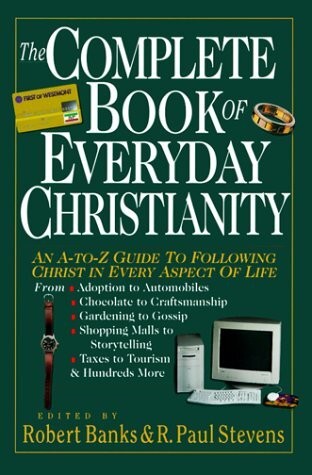
The authors Robert Banks and R. Paul Stevens have partnered with The Theology of Work Project to offer The Complete Book of Everyday Christianity in its entirety here. All rights reserved.
This resource was originally published in 1997, and the text has not been updated.