Vacations
Book / Produced by partner of TOW
The original meaning of holiday—holy day—contains a powerful suggestion: holiday making can become an experience of holiness in time. But for many people, family or personal vacations, if they take them at all, are times of spiritual dryness or exhaustion. Often people say they must return to work for rest! Even with our huge vacation industry, people are either bored or stressed out on vacations. So far as its original meaning is concerned, the word vacation simply means “a vacancy” (from the Latin vacatus), that is, “doing nothing.” But a vacation should have a more positive meaning than that. Getting out of our daily routines and working roles allows people to experience their individuality more fully and to be less programmed by what others expect.
A host of questions surrounds the practice of vacationing: Why do some people never take vacations or feel guilty if they do? In what ways do vacationing and sabbath observance overlap? Is an expensive vacation in a luxurious setting ever justified? Does the process of trying to justify a vacation destroy the very idea of taking one?
The Difficulty of Doing Nothing
Understandably vacations are very stressful for workaholics (see Drivenness) who do not want to be, or feel they cannot be, freed from the compulsions of work. One wife describes her husband on vacation in this way: The first day he calls back to work to cover what he forgot to do before leaving. Then he eats too much and gets sick, spending a day or two in bed. When he starts to come up from “under” his work, he seems to “get the bends” (like a diver returning too quickly to the surface). If we can get past the first week, he enjoys the second one but soon becomes preoccupied with all the work facing him when he returns to the office (Oates, p. 39). Christians are not exempt from such struggles. Often they feel they must justify the expenditure of money or time on nonproductive and nonreligious inactivity. Justification by faith—that watchword of the Protestant Reformation—has not been sufficiently translated from Sunday faith to Monday faith, from weekend to workday, nor has it been translated into sheer enjoyment of time, place, people and experiences for their own sake. According to Bertrand Russell, the modern person thinks that everything ought to be done for the sake of something else, not for its own sake (Oates, p. 40). This instrumental or functional attitude is deeply ingrained in the thinking of church people and must be challenged for a person to be converted to vacationing, a conversion that is part and parcel of our conversion to Christ.
The idea of a paid annual leave from work is a relatively modern phenomenon, and it is by no means universal. It is unheard of in some Third World countries and by millions who work in the service sector of society. Many professionals and self-employed people take vacations “at their own expense” with significant loss of revenue. Increasingly vacations in North America are becoming shorter, two or three brief times a year so work is not seriously interrupted (the European trend is somewhat different). Not surprisingly many choose not to take them at all or combine a short vacation with a professional conference in an exotic location. A whole industry has developed around incentive trips, which are designed to satisfy wanderlust and the work ethic at the same time, all at the company’s expense. It is argued that since they are offered to salespeople and managers whose performance has excelled, mornings in a conference and afternoons enjoying the amenities of a plush resort actually pay for themselves. This form of vacationing, if it may be called such, has been co-opted by capitalism to become a vital sales and marketing tool. Even without an incentive trip, travel and work remain well connected for many people.
On such trips—whether for business or pleasure (there is rarely any difference)—business executives take their cellular phones, fax machines and computers, even to the beach. The idea of vacationing loses its meaning if one takes along the infrastructure, seen or unseen, of normal stressful responsibilities. Many Christian academics and pastors have “working vacations” (an oxymoron) or “ministry trips.” There is reason to think that in spite of the huge leisure industry, the industrialized or postindustrialized information societies may have less restorative vacation experiences than older and less developed societies. So-called backward countries may be more advanced in some of the life patterns that really matter, such as visiting, conversing and resting. All too often in the so-called developed countries vacations have been reduced to a commodity to be consumed with the compulsiveness with which one must work in order to be “excellent.” It has not always been this way.
Is Vacationing a Modern Invention?
Festivals and holy days have been part of the annual rhythm of societies from time immemorial. They provided monthly or seasonal opportunities to engage in celebration, community events, religious ceremonies, feasting and revelry. Some of these were associated with the rhythms of the year in agricultural life (harvest or sheepshearing) or seasonal changes (solstice) and with annual migrations (for hunting, fishing or harvesting the orchards). Christianity often adopted and transformed these festivals into holy days, Christmas and Thanksgiving being conspicuous examples. The Jewish tradition is rich in holidays, such as Passover (Feast of Unleavened Bread; Deut. 16:1-8), Feast of Tabernacles (Deut. 16:13-17) and Ingathering (or Feast of Weeks; Deut. 16:9-12; see also Exodus 23:14-19). Three times a year the Israelites were required to set aside the normal rhythm of work and sabbath to undertake a pilgrimage to Jerusalem, often in a holiday mood, as the reference to Jesus’ remaining behind indicates (Luke 2:41-52). These were far from being dull religious events, for Deuteronomy prescribes buying food, wine “and whatever you like” (Deut. 14:26) with one’s tithe to experience the joy of the occasion. But some of the righteous or unrighteous wealthy Israelites could do even more.
The references in Amos to summer and winter houses, to “houses adorned with ivory” and “mansions” (Amos 3:15), to lounging on your couches and dining on choice lambs and fatted calves, to strumming “away on your harps” and drinking “wine by the bowlful,” (Amos 6:4-6) are a perceptive judgment on the rich Israelite playboys and playgirls who lived uncompassionate, self-centered lives and did not grieve over the fate of their nation (Amos 6:6; compare Genesis 37:26). While it is true that until modern times only the rich could afford to travel extensively and stay in luxurious hotels and spas—with opportunities now opened to the middle class through inexpensive air fares (see Traveling)—almost all people in all ages have found or exploited something like vacations. Prior to the global trend toward urbanization most people possessed discretionary time in winter during what is still called in farm areas “fence-mending time.”
In Waiting for the Weekend Witold Rybczynski traces the origin of the practice since the Industrial Revolution of staying home on Mondays, a practice that evolved into the institution of the weekend. The need for breaks in the routine of work is universal and is practiced even today, without calling them vacations, in the market days of Third World countries. The sabbath, which gets fuller treatment elsewhere (see Sabbath), was intended to be a weekly vacation to remember our roots, to celebrate creation and to gain perspective for the coming week—all facets of personal and communal restoration. The lack of sabbath in contemporary Christian life is a tragic indication of the need for recovering a theology and spirituality of vacationing.
Thinking Christianly
The mandate to enjoy God’s creation is an undertaking of grace that liberates us from judging our relationship to God and leisure in use-value terms and is an approach to the theology of time that delivers us from viewing time as a resource to be managed rather than a gift to be received (see Leisure). Great vacations, in one sense, can neither be planned nor managed. One further theme warrants consideration in an article on vacationing: a theology of place.
A theology of place is foundational to Christian vacationing. God created the world to be inhabited and filled (Genesis 1:28). Adam and Eve’s priesthood in the garden involved turning raw space into place: a garden with borders, animals appropriately named, plants nurtured, musical instruments invented and gold mined. The so-called nesting instinct is not exclusively a maternal drive. Even on camping trips men quickly turn raw space into a fire pit with a view, a “table and shelves,” where pots can be hung up, and a drying area, where clothes can be set out to dry.
Travelers, whether backpacking or riding the Concorde, long for resting places, an image Jesus used for his provision of a place (or places!) to experience in heaven (John 14:2; for movement as another theme taken up in Scripture, see Traveling). If some do not take vacations because they are taking themselves too seriously, others may not take them because they are taking their home too seriously—the house, garden and cat that cannot be left (for the opposite danger of not taking them seriously enough, see Mobility).
Taking a Vacation
In the light of the preceding theological reflection I offer some suggestions on how to take a vacation. First, plan to waste time rather than to fill up every hour with prearranged activity. Give God a chance to reach you! Second, find out what truly refreshes you (and your family) and do it: being beside a lake or sea (our chosen vacation for one month a year while the children were at home), visiting another culture (our present preference), sleeping a lot (something we do no matter how we “waste” time). Third, enjoy this leisure opportunity to pray, read Scripture and explore some of the spiritual disciplines you normally practice in a hurried way. Fourth, keep a journal and reflect on what you have seen and heard, turning these into prayers. A friend of our family takes a sketchbook and records a year’s worth of impressions later to be turned into paintings. I take my camera.
Fifth, avoid mixing work and vacationing, even working too hard at devotional things. Sixth, do things you normally “do not have time for,” such as reading books (if you are not reading for a living), refusing to read (if you read for a living), watching the clouds, visiting old friends or walking so slowly you actually see what is around you. Seventh, do not overdo vacations. People not accustomed to taking vacations should not start with a three-month trip with their family! In the same vein it is not wise to wait too long to have a vacation—until you are too exhausted to work and therefore, paradoxically, too exhausted to rest. Eighth, do not expect that some exotic place shown on a travel brochure will make you happy. You are responsible for your own happiness; it has little to do with how much money you have to spend. Ninth, take off your watch and live by the tides or the slant of the sun in the sky. Walk barefoot or fly a kite. Get in touch with God’s creation. Finally, enjoy God. Flyn, in Mister God, This Is Anna, puts rest and creation in perspective:
“Why did Mister God rest on the seventh day?” she began.
“I suppose he was a bit flaked out after six days of hard work,” I answered.
“He didn’t rest cause he was tired, though.”
“Oh, didn’t he? It makes me tired just to think about it all.”
“Course he didn’t. He wasn’t tired.”
“Wasn’t he?”
“No, he made rest.” (quoted in Hansell, p. 115)
References and Resources
R. Banks, The Tyranny of Time: When 24 Hours Is Not Enough (Downers Grove, Ill.: InterVarsity Press, 1983); R. Capon, An Offering of Uncles: The Priesthood of Adam and the Shape of the World (New York: Crossroad, 1982); T. Hansel, When I Relax I Feel Guilty (Elgin, Ill.: David C. Cook, 1979); W. E. Oates, Confessions of a Workaholic: The Facts about Work Addiction (London: Wolfe Publishing, 1971); “Off the Beach: Eight Awesome Alternatives to Sun, Sand and Surf,” The Other Side 22, no 2. (1980) 33-39; W. Rybczynski, Waiting for the Weekend (New York: Viking Penguin, 1991).
—R. Paul Stevens





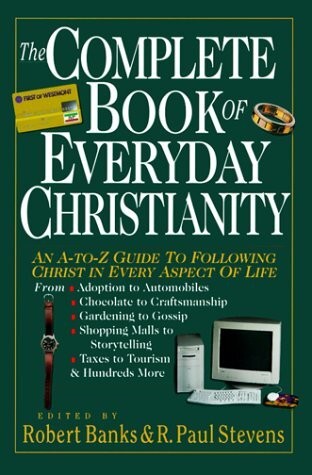
The authors Robert Banks and R. Paul Stevens have partnered with The Theology of Work Project to offer The Complete Book of Everyday Christianity in its entirety here. All rights reserved.
This resource was originally published in 1997, and the text has not been updated.